Best Cookware Sets
Nonstick Cookware · 2026

The best nonstick cookware sets. The coating, not the brand, decides how long any of them last.

Nonstick cookware comes down to one choice the piece count never tells you: PTFE or ceramic. PTFE — the slick fluoropolymer most people still call Teflon — is the coating behind every set on this page, almost always bonded to a hard-anodized aluminum body. It is still the easiest surface in any kitchen to cook an egg on, and it is a consumable no matter what it sits on top of. We compared published specifications, oven-safe limits, induction claims and current Amazon prices across five sets, from $98.99 to $329.95.

By Ilane TallUpdated November 10, 2026Research-based — no testing lab, no invented scores

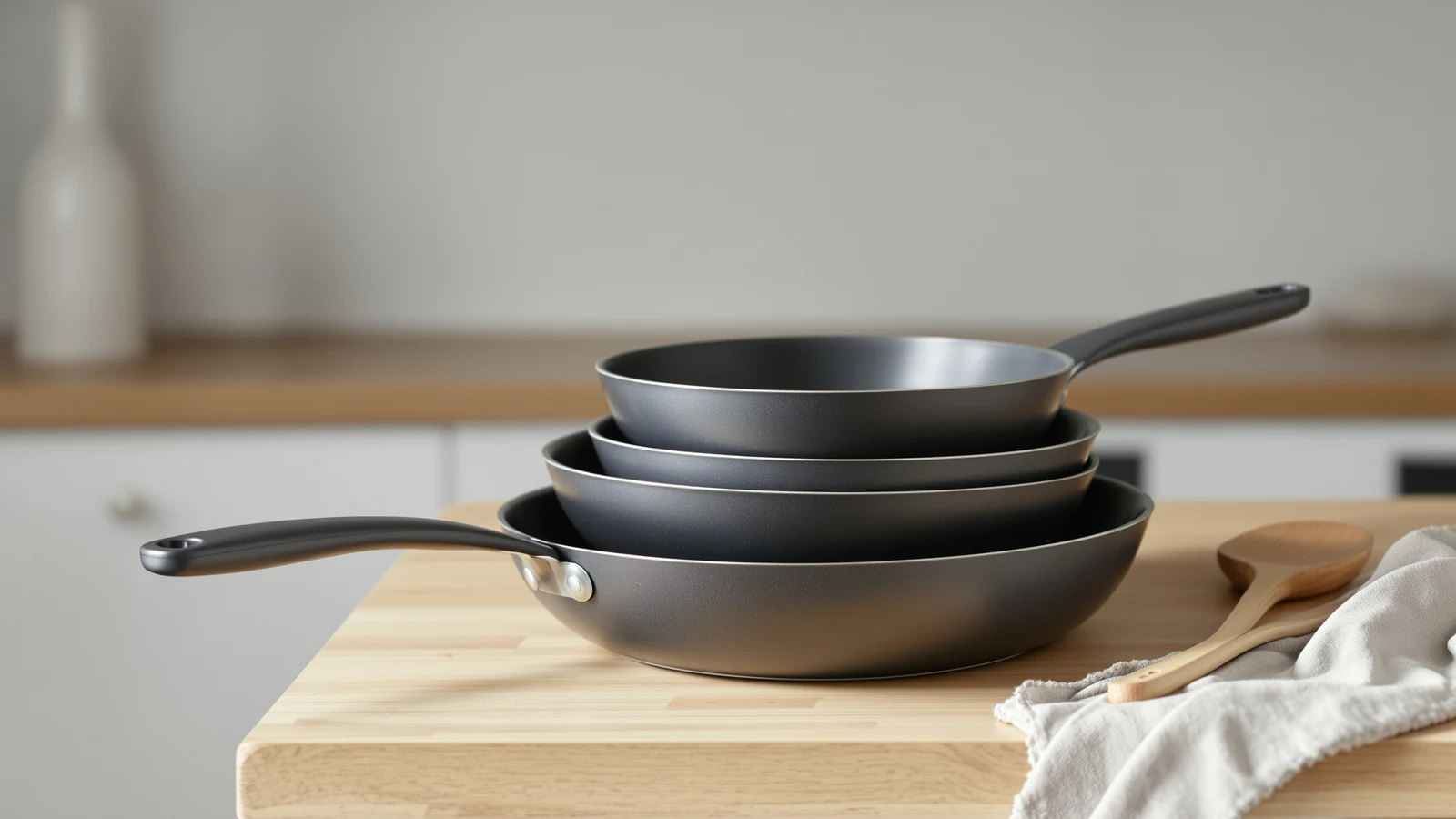
Several dark hard-anodized nonstick frying pans and saucepans with black interiors arranged on a kitchen counter

Affiliate disclosure: we may earn a commission when you buy through the Amazon links on this page, at no additional cost to you. See our About page for exactly how we research and how this site makes money.

The one to buy

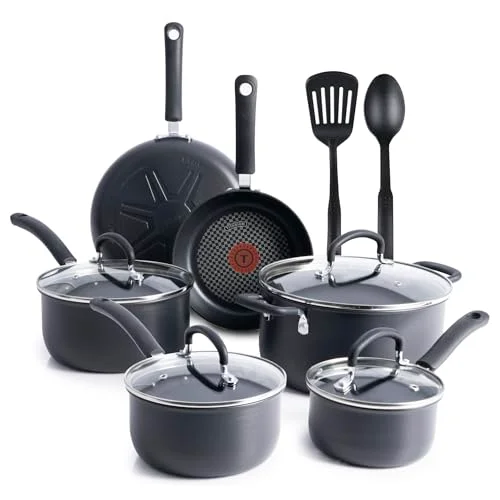
T-fal Ultimate Hard Anodized Nonstick 12-Piece

At $159.99 for twelve pieces, this is where most kitchens should start with nonstick. The body is hard-anodized aluminum; the coating is what T-fal calls titanium nonstick, and the listing is specific about its two real limits rather than vague about them.

T-fal publishes an oven-safe rating of 400°F for the pans and 350°F for the lids — the lower lid figure because a glass lid and its rim tolerate less heat than a solid aluminum pan does. That ceiling is well short of All-Clad’s 500°F, and the trade is close to the whole point of this guide: a nonstick coating wears out regardless of the number stamped on the box, so a set that gets the fundamentals right at $160 is a better bet than one that gets them right at $300. The same Ultimate line is on record stating it works on every stovetop except induction — if your range is induction, look at the All-Clad pick instead.

12 pieces·Hard-anodized aluminum body·Oven safe 400°F pans / 350°F lids·Not for induction
T-fal Ultimate hard anodized nonstick 12-piece cookware set
Price
$159.99
Check price on Amazon →

Prices change. We refresh them, but Amazon is the authority.

The real choice

PTFE or ceramic — and why this guide is about the first

What it is

PTFE: still the easiest release there is

PTFE — the fluoropolymer most people know as Teflon — has been in American kitchens for roughly seventy years, and nothing in general kitchen use releases an egg or a fillet of fish more completely. Every set in this guide uses a PTFE-family coating: T-fal calls its version titanium nonstick, Cuisinart calls its Quantanium a titanium-reinforced nonstick, and the rest describe conventional nonstick over a hard-anodized aluminum body. PTFE is built for low and medium heat, not for searing, and like any coating it is a wear item — years, not decades, is the realistic lifespan regardless of brand.

What it isn’t

Ceramic is a different material, covered elsewhere

Ceramic nonstick is a silica-based coating sold as PFAS-free, and as a material class it generally loses its slickness sooner than PTFE, though some ceramic sets publish higher oven-safe figures. None of the five sets below are ceramic, and we are not going to stretch their listings to pretend otherwise. If a PFAS-free ceramic coating matters more to you than PTFE’s longer-lasting release, our cookware sets overview covers a ceramic pick on induction. This guide stays narrowly focused on PTFE-on-hard-anodized sets, because mixing the two materials in one ranking hides more than it reveals.

The body

Hard-anodized aluminum: what the body actually does

The process

Harder than plain aluminum, and it won’t warp

Hard-anodizing runs plain aluminum through an electrochemical process that thickens and hardens its outer layer, turning it dark gray to black and far more resistant to scratching, warping and pitting than untreated aluminum. The aluminum underneath is what actually cooks: it conducts heat quickly and spreads it evenly across the base, which is why nonstick pans heat faster and more evenly than most stainless pans and why hot spots are rare on a well-made one. Every set in this guide — Amazon Basics, T-fal, Calphalon, All-Clad’s HA1 and Cuisinart’s Chef’s Classic — builds on a hard-anodized aluminum body for exactly this reason.

The limit

The body isn’t what fails first

Hard-anodized aluminum itself will outlast the coating sitting on top of it by years. What actually separates a $98.99 set from a $329.95 one is rarely the aluminum: it is coating thickness and reinforcement (Cuisinart’s Quantanium is explicitly titanium-reinforced), handle construction (Calphalon uses stay-cool stainless steel handles rather than molded aluminum or plastic), and how many of the published numbers — an oven-safe temperature, an induction claim — a given listing is willing to commit to in writing. Read the next two sections with that in mind.

Heat tolerance

Oven limits: 350°F lids, 400°F pans, 500°F for All-Clad

What's published

Two numbers, not one

The aluminum body is rarely the limiting factor in a nonstick pan’s oven safety; the coating, the handle rivets and especially the lid are. T-fal’s Ultimate line publishes two separate figures for exactly that reason: 400°F for the pans, but only 350°F for the lids, since a glass lid and its rim tolerate less heat than a solid pan does. All-Clad’s HA1 set publishes the highest figure in this guide, oven safe up to 500°F, which is the clearest sign of a coating and handle assembly built for harder use. Treat the lower of a set’s own published numbers as the real limit, not the headline one.

What isn’t

No number published is not permission

Amazon Basics, Calphalon and Cuisinart’s listings for the sets below describe them as oven safe without stating a specific temperature. That is common, but it is not a detail to guess at: if you plan to finish a dish in a hot oven or run these pans under a broiler, check the current listing or the manufacturer’s page for a number before you buy, and don’t assume parity with T-fal or All-Clad just because the construction looks similar. When in doubt, cook to the lower, published figure rather than the one you’d prefer to be true.

Stovetop compatibility

Induction: the steel plate most of these do not have

An induction cooktop heats only cookware with a magnetic base; plain aluminum, hard-anodized or not, is not magnetic on its own. A nonstick set earns an induction claim only when the maker bonds a magnetic steel plate to the underside of an otherwise aluminum pan. All-Clad states its HA1 nonstick set is induction ready, which means that plate is there. T-fal’s Ultimate hard-anodized line is on record stating the opposite: it works on every stovetop except induction. The Amazon Basics, Calphalon and Cuisinart listings referenced here make no induction claim at all, which under this site’s rule means we don’t assert one either — if induction matters to you and you’re looking at one of those three, confirm it on the current listing before buying, or hold a refrigerator magnet to a floor-model pan in store. There is no partial credit with induction: a base either completes the circuit or it doesn’t.

Side by side

The five, compared

SetPiecesOven limitInductionPriceGet it
T-fal Ultimate 12-Piece 12 400°F pans / 350°F lids Not for induction $159.99 Get it
Amazon Basics 12-Piece 12 Oven safe (no °F published) Not claimed $98.99 Get it
Calphalon 10-Piece 10 Oven safe (no °F published) Not claimed $229.99 Get it
All-Clad HA1 8-Piece 8 Up to 500°F Induction ready $299.99 Get it
Cuisinart Chef’s Classic 17-Piece 17 Oven safe (no °F published) Not claimed $329.95 Get it
The five

Our picks, and who each one is for

01Best overall

T-fal Ultimate Hard Anodized Nonstick 12-Piece

Best for most kitchens that cook on gas or electric

12 pieces·Hard-anodized aluminum·400°F pans / 350°F lids·Not for induction

The pan most people describing “easy nonstick” are picturing. The body is hard-anodized aluminum and the coating is what T-fal calls titanium nonstick, and the listing is specific where it matters: oven safe to 400°F for the pans, 350°F for lids, with the lower figure explained by the glass lids rather than the pans themselves. The Ultimate line is also explicit that it works on every stovetop except induction, so gas and electric ranges are the right fit. At $159.99 for twelve pieces, the price assumes you’ll treat the coating as a consumable, which is the honest way to think about any nonstick pan.

Twelve pieces for $160, with real oven numbers published rather than vague reassurance. That combination is why it leads this list.

T-fal Ultimate hard anodized nonstick 12-piece cookware set
Price
$159.99
Check price →
02Best budget

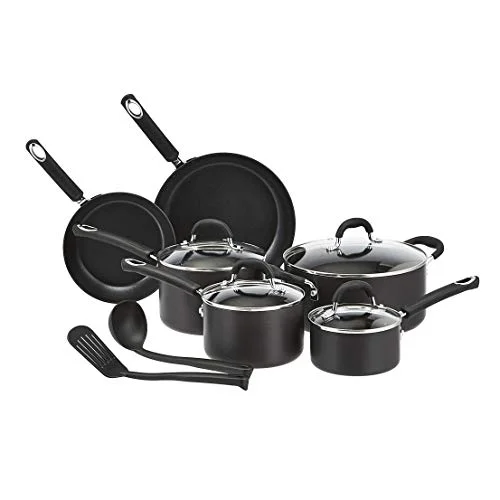
Amazon Basics Non-Stick Cookware Set, 12-Piece

Best for a first nonstick set, or a second kitchen

12 pieces·Hard-anodized aluminum·Dishwasher and oven safe·No induction claim

At $98.99, this is the cheapest way into a hard-anodized nonstick set at full piece count. Amazon’s own listing describes it as hard-anodized aluminum, dishwasher safe and oven safe, but it does not publish a specific oven-safe temperature or an induction claim the way T-fal and All-Clad do, so treat both as unknowns to confirm on the current listing rather than numbers to assume. What you are paying for at this price is the same basic construction as the rest of the category — a hard-anodized body under a nonstick coating — without the brand premium or the extra specification detail.

The least expensive full set here, and the honest trade is fewer published numbers, not a worse body.

Amazon Basics hard anodized nonstick 12-piece cookware set in black
Price
$98.99
Check price →
03Best handles

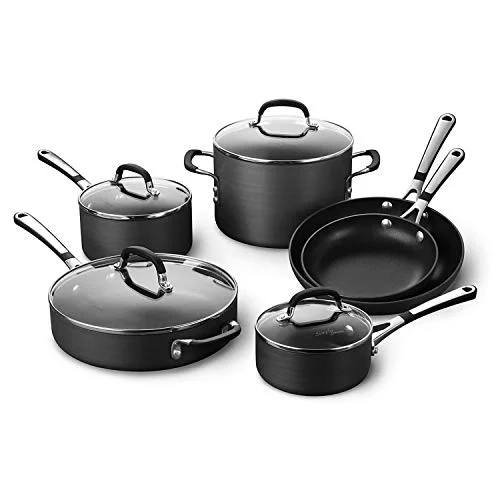
Calphalon Non-Stick Kitchen Cookware Set, 10-Piece

Best if hot pot handles are your main complaint about nonstick

10 pieces·Hard-anodized aluminum·Stay-cool stainless steel handles·No induction claim

Calphalon’s listing calls out one specific feature the others don’t: stay-cool stainless steel handles, riveted to a hard-anodized aluminum body built, as the listing puts it, for even heating. That is a real, checkable difference from molded aluminum or plastic handles, and it is the kind of detail worth $230 to someone who has burned a hand on a nonstick skillet’s handle before. The listing does not publish an oven-safe temperature or an induction claim, so confirm either before you buy if they matter to how you cook.

Ten pieces at roughly double the Amazon Basics price, for handles that specifically don’t get hot. A narrow reason to spend more, but a legitimate one.

Calphalon hard anodized nonstick 10-piece cookware set with stainless steel handles
Price
$229.99
Check price →
04Best for induction

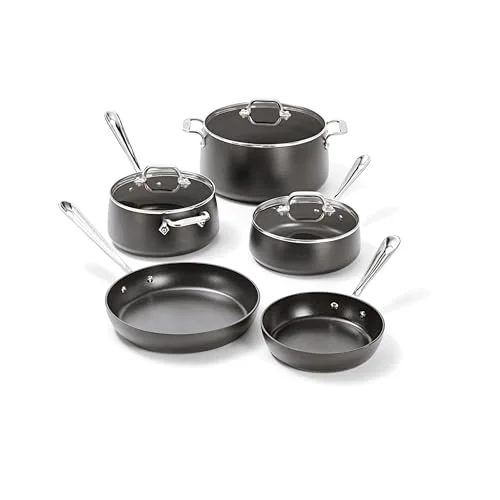
All-Clad HA1 Nonstick 8-Piece

Best for an induction range, or the highest oven ceiling here

8 pieces·Induction ready·Oven safe up to 500°F·Scratch-resistant exterior

The only set in this guide whose listing states induction compatibility outright, which means All-Clad has bonded a magnetic steel plate to the base of an otherwise hard-anodized aluminum pan. It also publishes the highest oven-safe figure here, up to 500°F, well above T-fal’s 400°F pans and 350°F lids. At $299.99 for eight pieces, you are paying for the most completely specified set in the group — a stated induction claim, a stated oven ceiling, and a scratch-resistant exterior — not for a coating that behaves fundamentally differently from the cheaper sets above it.

If your range is induction, this is the only set on this page that will heat on it. Everything else about the premium follows from that one fact.

All-Clad HA1 induction-ready nonstick 8-piece cookware set
Price
$299.99
Check price →
05Best for big kitchens

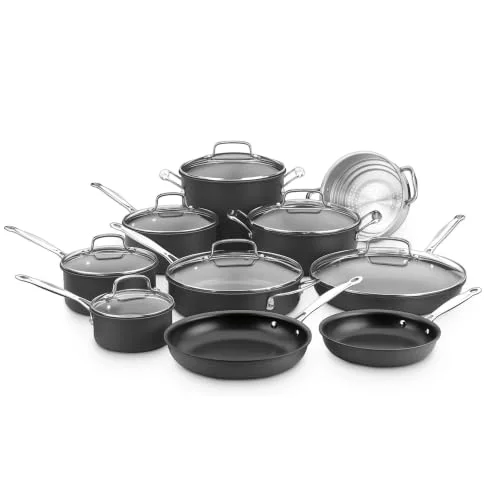
Cuisinart Chef’s Classic Nonstick Hard-Anodized Set, 17-Piece

Best for a household that cooks a lot of different things at once

17 pieces·Quantanium titanium-reinforced nonstick·Hard-anodized body·No induction claim

Seventeen pieces is the largest count in this guide, and Cuisinart’s point of difference is the coating itself: Quantanium, which the listing describes as titanium-reinforced rather than conventional nonstick, built onto the same hard-anodized aluminum body every other set here uses. Titanium reinforcement is a real, specific claim about coating durability, not a marketing adjective, which is why we can repeat it. At $329.95 it is the most expensive set in the group; the listing makes no induction claim and publishes no specific oven-safe temperature, so if either matters to you, check the current listing before buying.

The most pieces and the most reinforced coating on paper, for the highest price. Worth it specifically if you cook for a full table and expect the coating to earn its keep.

Cuisinart Chef's Classic 17-piece hard anodized nonstick cookware set
Price
$329.95
Check price →
The bottom line

Why the coating, not the brand, sets the lifespan

Line these five sets up by price and the range looks enormous: $98.99 to $329.95, more than a threefold spread for the same basic idea of a hard-anodized aluminum body under a PTFE-family coating. But the thing that actually determines how long any of them stays nonstick isn’t the number on the price tag or the name on the box — it is the coating itself, and the coating is a consumable on every single one of these sets, Cuisinart’s titanium-reinforced Quantanium included. High heat, an empty pan left on a hot burner, metal utensils and harsh dishwasher cycles will shorten any of them, regardless of what you paid. What the extra money does buy is real, but it is narrower than it looks: All-Clad’s premium buys a stated induction claim and the highest published oven ceiling in this group; Calphalon’s buys stay-cool handles; Cuisinart’s buys a titanium-reinforced coating and five extra pieces. None of it buys a coating that doesn’t eventually wear.

That is also why the Amazon Basics set at $98.99 is a genuinely reasonable choice and not just a compromise: it gives you the same hard-anodized aluminum body doing the same job of spreading heat evenly, at a price that matches what a wearing coating is actually worth. If a published oven-safe temperature or an induction claim is non-negotiable for how you cook, pay for the set that states it — T-fal for the oven numbers, All-Clad for induction. If neither is, the cheaper set will cook the same eggs just as easily, for exactly as long as any of them will.

Our method

How we compared — and what we can’t tell you

What we did

Specs, prices and what each listing commits to

We compared published specifications and current Amazon prices for five hard-anodized nonstick sets, read each manufacturer’s own listing for oven-safe temperatures and induction claims, and reported only the numbers a maker was willing to put in writing. Where a listing was silent on a spec — an oven-safe °F figure, an induction claim — we said so rather than filling the gap with an assumption, because a silent listing and a tested limit are not the same thing.

What we didn’t

We don’t run a testing lab

We do not physically test these sets, we do not own them, and we do not publish invented scores or star ratings — Amazon’s product data does not carry verified ratings for these listings. How a nonstick coating’s release actually holds up after two or three years of real cooking is not something anybody can answer from a short trial, including anyone telling you otherwise. What we can do honestly is read every published specification, compare prices as they stand today, and explain the trade-offs that follow from hard-anodized aluminum and a PTFE-family coating.

FAQ

Common questions

What’s the difference between PTFE and ceramic nonstick, and why does this guide only cover PTFE?

PTFE is the fluoropolymer most people call Teflon; it has the easiest release of any common cookware surface and has been in American kitchens for about seventy years. Ceramic nonstick is a different, silica-based coating sold as PFAS-free, and as a material class it generally loses its slickness sooner than PTFE, though some ceramic sets publish higher oven-safe ratings. All five sets compared here — Amazon Basics, T-fal, Calphalon, All-Clad and Cuisinart — use a PTFE-family coating over a hard-anodized aluminum body, so this guide stays focused on that material rather than mixing it with ceramic.

What does the hard-anodized aluminum body actually do?

Hard-anodizing is an electrochemical process that hardens and darkens the surface of plain aluminum, making it far more resistant to scratching and warping than untreated aluminum while keeping aluminum’s fast, even heat conduction. The aluminum does the cooking; the nonstick coating sits on top of it and is the part that eventually wears out. Every set in this guide uses this same basic construction, which is why the aluminum body itself is rarely the thing that fails.

What are the actual oven-safe limits on these sets?

Among the sets compared here, T-fal publishes 400°F for the pans and 350°F for the lids — the lower figure because glass lids tolerate less heat than the pans. All-Clad’s HA1 set publishes the highest figure, oven safe up to 500°F. Amazon Basics, Calphalon and Cuisinart describe their sets as oven safe without stating a specific temperature in the listings we compared, so confirm the current number before broiling or finishing a dish in a hot oven on any of those three.

Will any of these sets work on an induction cooktop?

Only if the maker has bonded a magnetic steel plate to the base, since plain hard-anodized aluminum is not magnetic on its own. All-Clad states its HA1 set is induction ready. T-fal’s Ultimate line states the opposite — it works on every other stovetop except induction. Amazon Basics, Calphalon and Cuisinart make no induction claim in the listings we compared, so treat induction compatibility on those three as unconfirmed rather than assumed.

Keep reading

For how nonstick stacks up against clad stainless and ceramic across the whole category, see the full cookware sets buying guide on our homepage. For how we research and how this site makes money, read our About page, browse all guides, or get in touch if you spot a price or spec that’s gone stale.